

Personal Hygiene
Keeping Clean & Healthy
Recent studies, as well as plenty of anecdotal evidence, have taught us that one of the most common (and most uncomfortable) questions people have going into a field experience like JIRP are about personal hygiene. Our aim at JIRP is to actively create an atmosphere where the barriers to entry are as low as possible. In that spirit, we want this particular set of questions to be as transparent and un-intimidating as possible. If your questions are not answered here, please reach out to our staff! We are happy to answer questions to alleviate anxiety about this part of the JIRP experience.
Handwashing
At the center of every camp, usually right outside the cookshack, is a handwash station. The handwash station is an insulated container full of warm water, a basin below the spigot to catch the water, and a pump bottle of biodegradable hand soap. At the handwash station, there is also a two-burner propane stove and pots for heating up water for non-drinking uses (handwashing, laundry, showers, etc.).
All participants are required to use the handwash station after using the outhouses and before meals (you will be publicly shamed by your peers if you do not). Our goal is to keep everyone healthy on the Icefield, and handwashing is a huge part of how we prevent nasty sicknesses from spreading. Nobody wants norovirus when living in a field camp without indoor plumbing. Wash your hands!
Showering & Bathing
Most JIRPers shower and bathe less often in the field than they do at home. If you’ve never slept outside before, or never gone on a week-long backcountry trip, this may be an adjustment for you. We find that almost everyone adapts, and it certainly helps that everyone is in the same boat.
There is one shower in every camp. It is in its own room, so it’s totally private. We don’t have plumbing on the Icefield, so the showers are gravity-fed. Essentially, the shower is comprised of a bucket, a hose, and a traditional showerhead in a stall with an on/off valve. To use the shower, you heat water on a stove reserved for non-kitchen use, haul the water to the shower in buckets, and fill it up yourself. We don’t monitor shower use, so you may use it as often as you like. We do monitor meltwater for the sake of meeting critical drinking water and camp needs. When meltwater is running low, the Camp Manager may limit showers and laundry for a few days.
When meltwater is low, time is short, the sun is out, or enthusiasm is high, it’s also common to take a snow bath. This generally involves stripping down to shorts/sportbras at the edge of camp and scrubbing yourself with snowballs. There is often a fair amount of yelping involved with snow baths! It’s not to everyone’s taste, but it’s certainly worth a try if this is your first summer living on a glacier in Alaska.
JIRP students explore all sorts of new ideas during the summer. For some students, this means thinking about whether they need to shower at all. Others prefer to shower more often. There’s no right or wrong answer, and we give you as much leeway as we can to do what makes you comfortable.
Laundry
Participants do their laundry by hand on an "as needed" basis. We usually have a steady supply of clean melt water, stoves to warm it up, and basins available. Participants should bring their own supply of biodegradable soap (Dr. Bronners and CampSuds are popular options). The Field Staff can go over laundry washing techniques with anyone who hasn't done laundry by hand before. We dry wet laundry outside on sunny days and on clotheslines over the camp generators (just don’t put synthetics too close to the hot generator unless you want melted clothes).

On the first sunny day after a stretch of rain, every surface in camp is suddenly covered in drying laundry. Photo by Ellie Miller.
Bathrooms on the Icefield
In Permanent Camps
Every camp has a number of pit toilets, which we call “outhouses”. JIRP Outhouses are small buildings built over a hole in the ground. There is a bench inside with a toilet seat. Everything that your body creates (urine, feces, etc.) can go down the pit. Every outhouse has a trash bag for everything your body doesn’t create (toilet paper, trash in your pockets, disposable menstrual products - see the Menstruation page for more info on that). This system slows down how fast our outhouses fill up so that we don’t have to move them or shovel them out. Each outhouse also has a bottle of hand sanitizer, and we ask participants to use the handwash station to wash up after doing their business and hand-sanitizing.
Every outhouse is gender-neutral. With one exception, every outhouse is single-occupancy. Choosing to use the double-occupancy outhouse with a companion is a rare thing and not an expectation.
Every camp has a designated spot for outdoor urination at the edge of, and facing away from, camp. With 60+ people in camp and only a few outhouses, this is mostly a time-saving norm. Anybody is welcome to make use of this spot, and no person is required to use it. Some people don’t mind the public aspects of this; some people are very uncomfortable with it. Again, it’s all personal preference and we try to keep everyone as comfortable as possible.
We are actively exploring options to improve our human waste disposal with the help of some courageous alumni and the support of the Forest Service. Standby in the next few years for progress here!
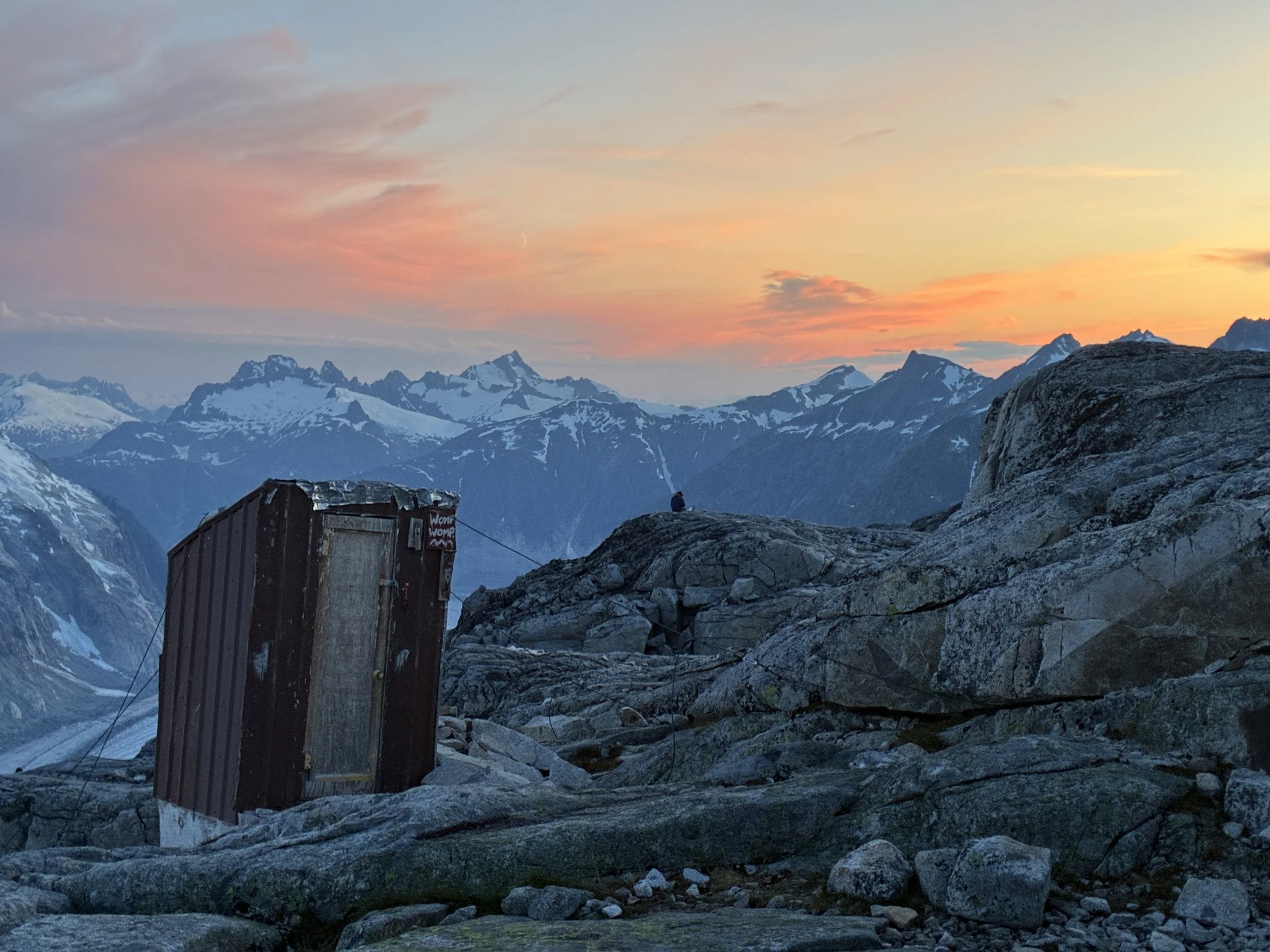
Each outhouse has an open/closed sign on the outside so you can tell from afar if it is occupied.
On Day Trips
The point of JIRP is to get everyone into the field - both on the glaciers and on the surrounding mountains. With eight- to ten-hour field days being common, everyone ends up having to urinate or defecate in the field at some point. The glacier is a flat, white plain for at least hundreds of yards/meters (and potentially several miles/kilometers) in every direction. It’s neither safe nor a good use of time to travel far enough away from the group to achieve privacy. Therefore, in the field, we’ve developed a series of norms around privacy and bathroom use.
The routine is you ski about 60 ft/20m away from the group, dig a hole if you’re pooping or emptying a menstrual cup, and do your business. Folks who are squatting to use the bathroom are encouraged to face the group - when you squat in this position, other people can really only see your face, your shoulders, and your shins (still covered by your pants). If you stand to pee, face away from the group. We leave human waste on the glacier, so there’s no “packing it out” procedure. It’s entirely possible to use the bathroom wearing a mountaineering harness (both squatting and standing), and the field staff will go over this procedure during orientation.
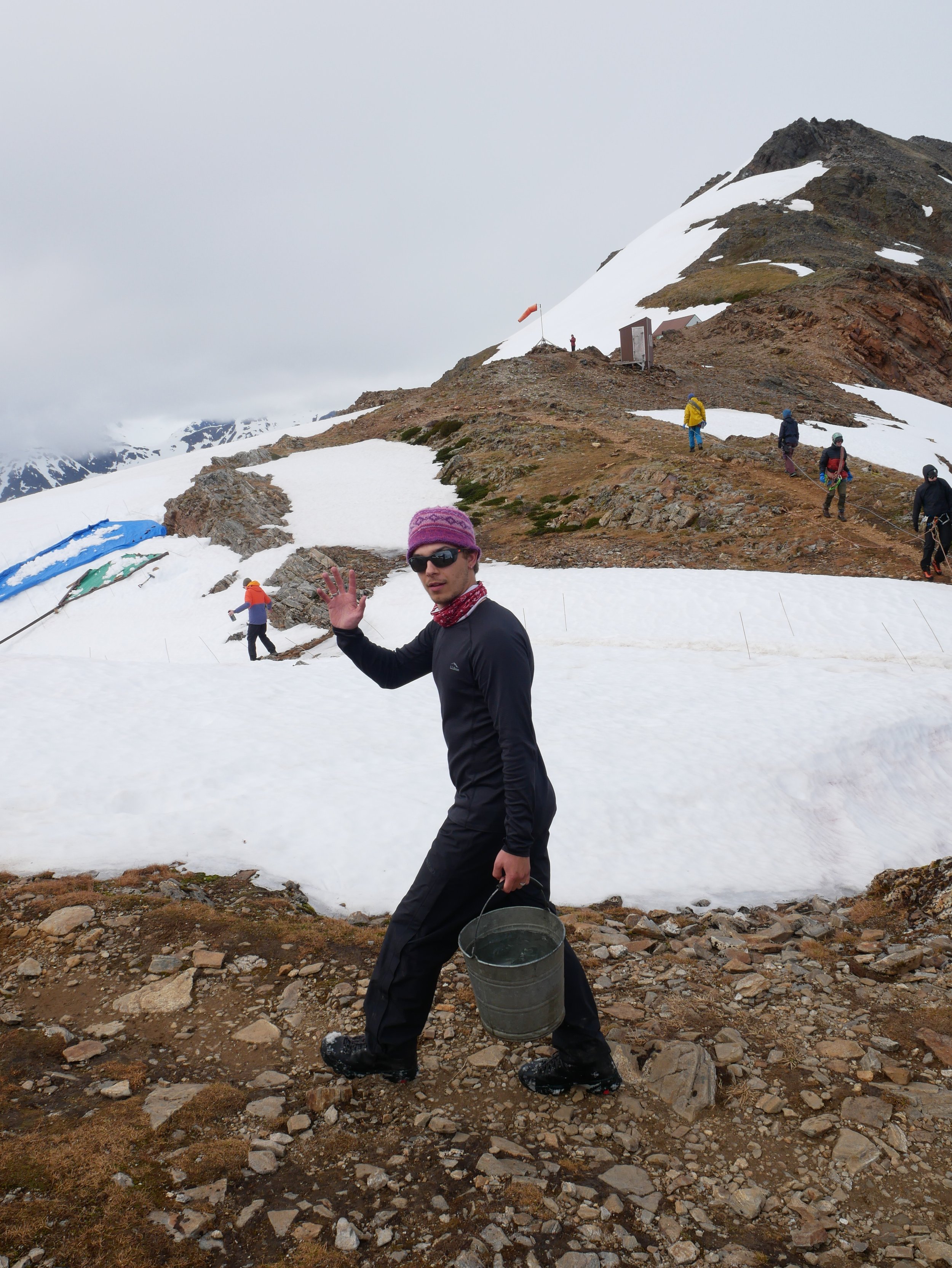
Carrying water from the meltwater barrels to the stove to be heated for handwashing.
At Tent Camps
For a few nights at a time (or longer for research teams), you may be staying at a temporary tent camp on the glacier. At tent camps, we dig latrines - deep pits in the snow for human waste - behind a snow wall. Every latrine also has toilet paper and a trash bag (for used toilet paper), similar to an outhouse. In tent camps, we don’t have handwash stations. Instead, we scrub our hands off with snow (it’s fairly abrasive and wet) and use a lot of hand sanitizer.
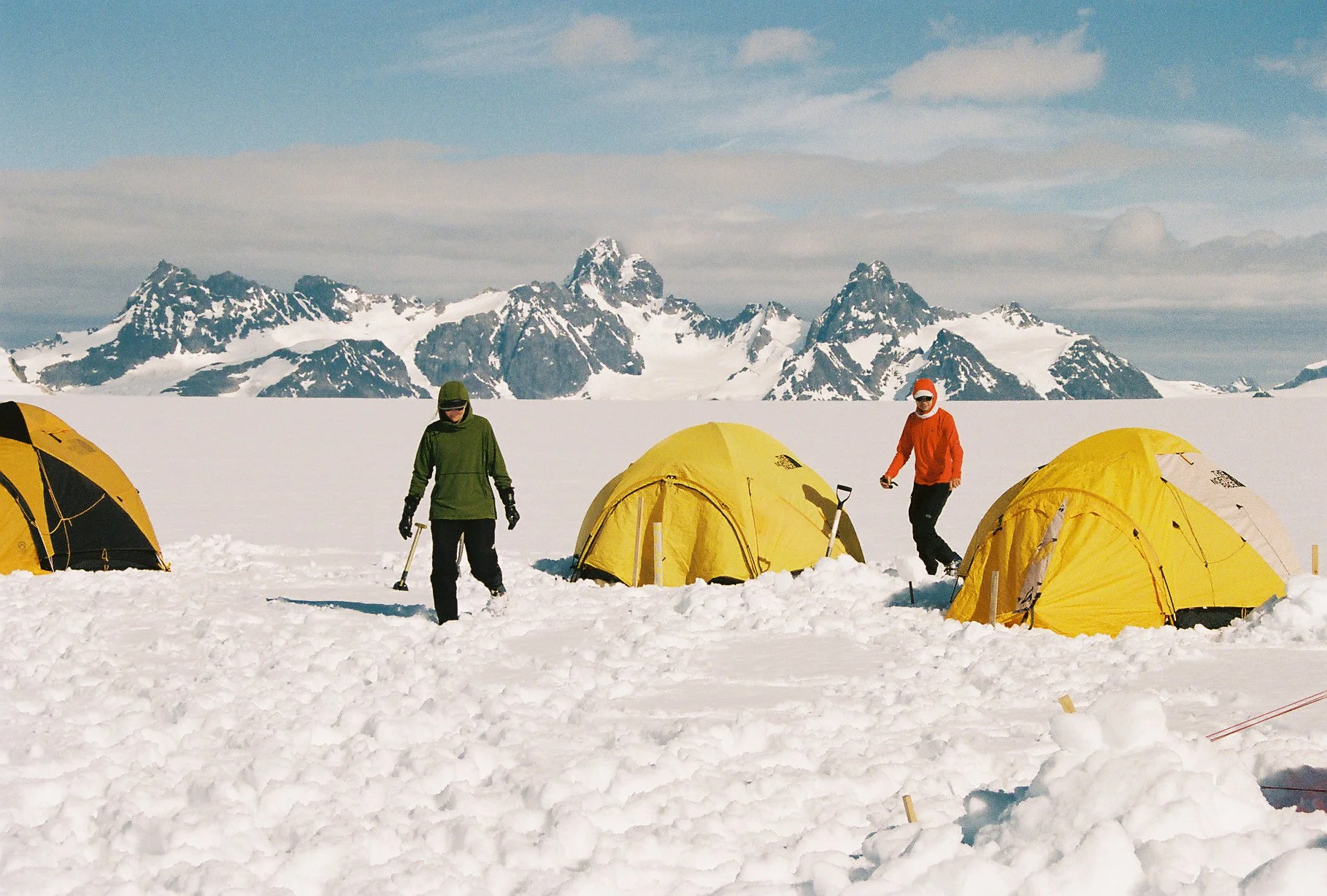
When staying in tent camps, a bathroom area will be designated on the opposite side of camp from the water supply area.